Hi, thank you for being here, and may God bless you, protect you, and your family, and may He grant you all of your heart’s wishes and desires. 🕊️
My prayer for you as we begin is this: whatever is hurting you, and whatever you’ve been stressing about, gets better. May the overthinking, the doubt, and the dark thoughts leave your mind. Where there was chaos, let there be rest. May truth clear your mind, and an unshakeable calm steady your heart today. Amen.
Prayer boards are powerful. Any vision that is attached to the Word of God is undeniably powerful — after all, this is the word of the King. So before we talk about how to set up a prayer board, we have to talk about a couple of things about the essence of a prayer board. A prayer board is planning with God.
Here’s the thing about planning: the Bible never tells us not to do it. Planning is wise. It’s smart. What scripture warns us about is planning like God isn’t in the room.
James 4:13–16 (ESV):
“Come now, you who say, ‘Today or tomorrow we will go into such and such a town and spend a year there and trade and make a profit’ — yet you do not know what tomorrow will bring. What is your life? For you are a mist that appears for a little time and then vanishes. Instead you ought to say, ‘If the Lord wills, we will live and do this or that.’ As it is, you boast in your arrogance. All such boasting is evil.”
When we put God first and we approach our prayer boards by declaring the Word of God and by praying over our visions and goals, something happens. By the way, I am a firm believer that whatever is deep in your heart — meaning when you strip away the vanity and the artificial — that is from God.
And if your vision is grand and it scares you, and yet you have faith in God — something shifts. You create a prayer board and you see it every day, and you declare the Word of God, and you believe that to God nothing is impossible — then your prayer board has transcended.
What I’m doing instead is flipping the whole approach. Instead of “I want this, I’m attracting this, I’m speaking this into existence,” it becomes “here’s what’s actually on my heart — Lord, shape it.” One centers you. The other builds obedience instead of just chasing desire. And honestly — what’s the point of God handing you the blessing if you haven’t grown into the kind of person who can actually hold onto it?
For two years I prayed this way — just asking, asking, asking — without ever stopping to ask whether I was actually taking care of what God had already put in my hands. Then I landed on Luke 16:10: whoever’s faithful with a little will be faithful with a lot. That changed how I built my board. One half is everything I already have that I’m responsible for growing. The other half is what I’m still believing God for.
How I actually built it, if you want to do the same:
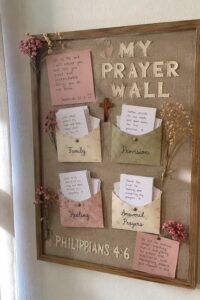
I picked 12 areas total — six I’m stewarding, six I’m believing for. For each one, I found images on Pinterest that captured the feeling of that topic and put together a little collage — turns out there’s real science behind how seeing something visually, alongside scripture, helps it actually stick with you. I arranged everything on the poster board first, six on each side, before committing to anything. Spelled out “PRAYER 2026” across the middle with vinyl lettering, then glued it all down — a clear-drying glue stick works best since some of the images overlap.
Then I grabbed the smallest envelopes I could find (they hold better on the board), wrote one topic per envelope matched to its collage, and added a scripture on each one that fit the theme — highlighted so it stands out. Thumbtacked each envelope onto the board once everything was placed.
I keep mine somewhere private, not out on display — this is between me and God, not decoration for guests to see. Mine lives in my bedroom.
The daily part is what makes it work. Every morning I pick one of the 12 topics, read its scripture out loud over coffee, and pray it — including praying for someone else who might be touched by whatever God does in that area of my life. Then I ask Him for one obedience step: what can I actually do today because of this? I sit for a minute and write down anything I sense Him saying, and if nothing comes, that’s fine too. The card goes in its envelope, dated. Miss a day, no big deal — just pick it back up.
Come next year, I’ll go back through every card and mark the ones He answered. That’s the part that really builds your faith — seeing it laid out in your own handwriting, proof that He was listening the whole time.
If you build one of these for yourself, don’t just hang it up and hope. Put real action behind what you’re praying. Use it to actually meet with God every day — and steward what’s already yours before you go chasing what isn’t.